
-
Blog Stats
- 27,664 hits
-
Recent Posts
-
Top Posts & Pages
Blogroll
Categories
Archives
- October 2018
- August 2018
- July 2018
- April 2018
- October 2017
- August 2017
- January 2017
- November 2016
- October 2016
- August 2016
- July 2016
- May 2016
- April 2016
- March 2016
- November 2015
- October 2015
- July 2015
- June 2015
- February 2015
- January 2015
- December 2014
- November 2014
- October 2014
- September 2014
- August 2014
- June 2014
- May 2014
- April 2014
- March 2014
- February 2014
- January 2014
- December 2013
- November 2013
- October 2013
- September 2013
- August 2013
- July 2013
- June 2013
- May 2013
- April 2013
- March 2013
- February 2013
- January 2013
- December 2012
- November 2012
- October 2012
- September 2012
- August 2012
- July 2012
- June 2012
- May 2012
- April 2012
- March 2012
- February 2012
- January 2012
Meta
Pen in Hand
The Expert
By Catherine Hedge
I’ve always admired experts. I’m one of those who sit in the front seats of a lecture hall. I hold my breath at the introduction and stare adoringly at the speaker. Then with a fat notebook and quick pen, I try to capture the moments of inspiration. At the end, I sigh as if a beautiful symphony has just ended.
So, I trained to be an expert. An English teacher. I assumed that I would waltz into the classroom, raise my pen like a baton, and direct my students to become incredible writers. They would swoon at my brilliant poems and beg me to read more! More! MORE!
That’s not how it happened at all. No Sirree! The biggest revelation in my career sounds like a cliché, but it’s true. I really did learn more from my students about writing than all of my college coursework. And I had excellent professors for the most part! (Thank you Dr. Gilbert and Dr. Bushman!)
My initial premise was wrong. My middle school students weren’t just empty vessels waiting for me to fill them. Instead, they were already rich in background knowledge, the books they had read, the stories they’d heard or seen, and the dramatic experiences of their young lives. They had valuable writing instincts. With some training in critique, they could express those thoughts to support others and to hone their own pieces.
I recently found an example of their helpful criticism while cleaning out my old files. Back in the mid 1980’s, we were working on a Greek God unit. I was taking a Whole Language class taught by Dr. JoBeth Allen that was based on a novel idea: If you want to teach students to write, let them write and talk about writing. For my college assignment, I had my children spend 10 minutes creating a quick origin story. I wrote along with them. Then we passed our papers around for comments. (This was after instruction and modeling of appropriate feedback.) When I was done with my little piece, I was proud. Not too bad for a rough draft. Succinct. Clever end. I hoped my 7th graders would be impressed.
The following is a transcript of my initial story, their comments, and my response thirty years later.
10 Minute Quick Write: How People Fall In Love by Catherine Rintoul (at the time)
Long ago and far away, life was incredibly dull. No one fought or cried or laughed with glee. Zeus became quite bored with his creations and was ready to squash them into homogenized humans.
Venus, who had always been fond of the weak beings, decided to spice up their lives. She let loose a cloud of azure butterflies. These flew through the dark and into the mouths of the young who were forced to sleep under the stars.
When a young male human awoke with a start, he snapped his mouth closed and trapped the fluttering butterflies inside. Looking for the cause of his distress within himself, he spied a young beautiful maiden asleep under the nearest tree. He blamed her, woke her up, and the world has never been the same since.
(Argh! On rereading this, I ask myself, did I really say “Laugh with glee” Or “Awoke with a start”? I’m so sorry! C.H.)
Student comments: (My observations)
“The people should have went (sic) through some emotions.” Theodonte (Dang! He’s right!)
“Why not make the butter thing taste like anything?” J.C. (Yes. A great place for sense detail. Now, would it be bitter or sweet?)
“Why don’t you add other gods in the story?” C.G. (Too many names in a short piece)
“Why didn’t they fight?” K.O.G. (again, I didn’t describe the lack of emotions. I just assumed the statement was enough.)
“I think they should have awoke and ran to each other and kissed.” K.B. (Hmmm…probably the scene young readers would have liked to have seen most and I left it out. I presumed they’d make the connection or imagine the moment, but I was giving up my author’s control)
“You could have one of the bullerflies fly in Zeus’s mouth and he falls in love.” (Brilliant! No name, but I wish I knew who wrote this. He or she is probably a successful screenwriter now. )
“This is good. I think you should change the butterflies and have flies.” C. W. (Good yuck factor.)
“ I think you should have lots of people getting off the ground and running toward each other.” C.B. (I agree…and have Zeus respond to the pandemonium. Much more active ending. Could be panoramic.)
“I think you should have it the same.” N.Y. (Sometimes we need one of these, too!)
“I think you should have something like raining peppermint drops, melting at the touch of lips or tongue instead of butterflies.” S.O. (Hmmm….more specific descriptive detail in this sentence than my whole piece.)
“Why were they force to sleep under the stars?” A.M. (Ahh, a cry for conflict. Tension. Injustice. Dang. Right again. )
These students are now nearing forty. I wonder if any of them, and the students who followed, realize how much they transformed my life. I was an intelligent, somewhat pompous instructor who excelled in creating reports, research papers, and lesson plans. However, inside I was a suffocated storyteller. A creative writing professor told me I had no talent. I stopped writing that day. I was secretly terrified that my students would discover the truth about me.
I am a fortunate woman. My students made me write, revise, share…they insisted I follow the same processes I made them use. Together, we used the techniques that turn bland work into something memorable. Later that semester, I met Leonard Bishop. He asked me, “Are you working on anything?” By that time, I had enough courage to say, “Yes!”
The truth did finally come out, but it wasn’t what I had feared. “Talent” didn’t write. I did.
Posted in Leonard Bishop, Slice of life, Teaching, Writing
Tagged Dr. JoBeth Allen, JoBeth Allen, Leonard Bishop, Middle school writers, Reminiscence, student critique, student writing, teaching writing, Whole Language, writer's block, writing criticism, writing inspiration, writing techniques, young writers
2 Comments
Hearts Aren’t Crystal
Posted in Slice of life
Tagged broken heart, divorce, friendship, grief, healing, healing broken hearts, heartbreak, love, reconciliation, Reminiscence, slice of life
Leave a comment
Hearts Aren’t Crystal
By Catherine Hedge
I once read a old fairy tale about an innocent girl who met with tragedy. The Ice Queen broke a magic crystal. A shard flew through the air, piercing the child’s heart. Originally sweet and loving, she became increasingly cruel and rigid while her brother tried to save her. I wonder if that’s what happens when our hearts are broken. Sharp fragments bury themselves into our psyches and dare us to pry them out.
I’ve never met anyone over fifteen who hasn’t had a broken heart at least once. Sadly, most of us experience it multiple times and know all the platitudes people use to make us feel better:
“Just keep yourself busy. You’ll get over him/her soon enough!”
“No one ever died of a broken heart.” (Are they so sure?)
“If it were real love, none of this would have ever happened”
“Just wait. Someone better will come along.”
You know they mean well, but all you really need is someone to wrap both arms around you, to say, “I am so very sorry….”, and to listen. Sometimes it seems you’re asking them to listen forever. You tell the same story so often your sister, brother, mother, friend could say the next line, but still the spinning of it is healing.
You need someone to say, “It really wasn’t your fault.” Even if it was. You need to talk about little moments, insignificant before the break-up, that become magnified into monumental foretellings. (Why didn’t I see it coming? How could I have been so naive? Why wouldn’t he/she change when he/she knew I needed him/her so much?) Characteristics that were once endearing when you loved the person become traits that drive you crazy. Places you adored, holidays you cherished, friends you shared, you avoid in the aching, dulling aftermath of a soured romance. That shard of heartbreak can keep digging deeper, shredding your spirit until it seems there is nothing left.
Some creatures really are made to love only once. My daughter told me a story of a friend who used to hunt wild geese. He was very proud of bagging a large goose until he saw the gander circling, landing, and calling out for hours for his lost love. The sound was so mournful, he never hunted geese again. The story is that goose may have returned to search for years, that they mate for life.
 But humans are lucky. We do have the capacity to love again, if given the chance. Perhaps a dear friend, a new lover, or our child reaches inside us and finds that old injury. Somehow, with patience and hope, they tweeze out the slivers of glass. That makes us love them even more.
Posted in Slice of life, Uncategorized
Tagged broken heart, divorce, friendship, healing, healing from divorce, heartbreak, loving, power of love, relationships, Reminiscence
7 Comments
Notes from Leonard Bishop’s class, 1977-78
Part One: May 2 to May 9
I’ve had these notes tucked away in a drawer for a long time, and they’d been calling to me. These are from a writer’s workshop that met back in the 70s, made up of students who’d been in Leonard Bishop’s UC Berkley extension class. Going through them was like puzzling out lines of an old papyrus — I wish I’d written more neatly back then! Still, the bits and pieces I salvaged illuminate the writing process as only he could — I thought they’d be helpful to anyone struggling with a novel. And those who studied with Leonard will probably be able to hear him while reading this.
Here are two weeks’ worth; I’ll post more as I transcribe them:
May 2, 1977
“It’s not important that anyone think of you as a good writer — what matters is, can you get to what you need? Forget style — it handicaps getting to content. Content carries you.”
This one I love. He’s giving you the freedom to be messy. If you’re trying to be literary while you write a scene, it’s all over.
“Content” was one of his favorite words. It popped up constantly. You had to be in the class for a while to puzzle out exactly what he meant by it. It doesn’t just mean having something happen in your story. It’s more than providing a good strong motivation for your character. “Establishing a conflict” almost covers it but not quite. It’s all of these and greater than the parts. I just know I got it wrong dozens of times before I ever got it right.
“By chapter 10, there are no simple episodes. Many complications have occurred by then; the scenes are a compendium of events that have already taken place.”
“Be more versatile in what you have people do — you need versatile situations that absorb the complexity of what precedes them. Go from the immediate to the wider picture.”
(Said in response to a student’s chapter)
“You are still writing on capabilities that already exist. You’re not reaching for other ways of presenting material. The material lacks versatility, invention — it’s stuck in sameness. A series of adequate chapters adds up to the mundane. Take chances.”
“Change should happen on scene — it shouldn’t be summarized, quickened or glossed over. Narration deals with less valuable material.”
“Write fast. Don’t let go until you say all you have to say. Linger on details.”
May 9, 1977
“Discover the use of the scene and don’t put more in. You don’t need an in-depth probe of a character’s motivation. You don’t have to even know the motivation — many things you couldn’t know. Keep a scene short. Show the moments of illumination. Do it visually. Use small paragraphs at the beginning, then lengthen them. Don’t go into detail about a character whose function is merely mechanical. Find the range of your focus. Have a point of revelation. Select from many possible scenes. And don’t settle for a scene just because it’s the only one you can think of.”
It surprised me that he thought you really didn’t need to know why your characters did what they did. People are complicated, he would say; no one understands anyone else, anyway, so readers will accept it! Related to this is something I heard him say repeatedly: “The writer herself is so much more fascinating than the characters she creates.” (Yes, he often said “she,” something I loved at the time.)
Scene selection was another of his favorites topics. He taught me to think in terms of “trying out” scenes — like you’re auditioning them, more or less. Or running experiments in a lab. You expect most experiments to fail.
Which is why writing a novel takes so damn long.
“Don’t spend a lot of time on secondary characters before the main character has started off — he is like a frame holding everything else.”
Said of the short story I handed in that week:
“The writer overwhelmingly tells the story. It is never acted out. (You are) caught up in the flow of the prose…after a while it becomes facile…. You have to hold a scene down. Your scenes aren’t scenes, but contributors of information. Create the same effects through different scenes. You should be able to tell your story 1000 ways.”
This was a problem I never did iron out until I stopped writing short stories and started a novel. I was drowning in my own prose. The big shift came with chapter 8. I had things happening so fast in that chapter, to me it read like a cartoon strip. But Leonard loved it. I thought he was nuts. And it was wise of him, too, to lay off criticizing all the other things that were still wrong with that chapter. He was just so happy I’d learned to make things move.
“Think of your book as a wheel. The first chapter is the hub — it is the place of emergence. The second and third chapters are spokes. The final chapter is the rim.”
Robin Eggs and Dinosaur Feathers
Posted in Slice of life
Tagged child-raising, grandparent, knowledge, learning, life-long learning, nostalgia
Leave a comment
Robin Eggs and Dinosaur Feathers
By Catherine Hedge
 When I was little, my religion teacher told me that when you died, you’d know everything instantly. For weeks afterward, I tried to figure out if there was a way to die just a little bit. There was so much to learn and I wanted it NOW! I toyed with the idea that if I was lucky, I’d also discover how to resurrect myself. Voila! Instant brilliance.
My naturally cautious nature prevailed. I decided to just grow old. Grandpa Borel was a renowned engineer from the Montana School of Mines. I believed he was the source of all knowledge and that age made him that way. All I had to do was wait and my brain would fill up like a bucket at the bottom of a drainpipe.
Well, my hair is gray, my skin easing into wrinkles. Age is coming…gently…but that infinite knowledge is farther away than Jupiter. I know now why my enduring image of Grandpa is his newspaper ritual. He’d pull me into his lap, read the headlines out loud, and explain the ones he thought I should remember. He passed away after a long decline when I was 12, but he had already convinced me that “Learning” wasn’t a finite entity. It was my responsibility.
I’m lucky. Along the way, great people helped me discover how much fun new knowledge can be. I have to set a timer when I go “just looking” on the Internet. Stumbleupon is dangerous! I have a hundred books on my shelves waiting to be read, and then I discover Project Gutenberg. I celebrate National Poetry Month by checking out The Poetry Foundation with over 10,000 poems for free and the PBS site for submitting children’s work. Last week, Google began putting art museums on line from all over the world. You can zoom in so close you can see the brushstrokes!
Ah, yes, the choices are limitless. However, I am now discovering that of all the possible ways to learn, the one that delights me most, is my very first. In reverse. Every day, I get to see my five-year-old grandson explore the world. Friday, we stared at Rodin sculptures and compared his hands with The Thinker, his favorite. Yesterday, we watched a red-winged blackbird scare a duck from the rushes. This morning, we saw a newspaper picture of a feathered dinosaur and then held an abandoned robin’s egg still cool with morning dew.
After almost 50 years, I can hear Grandpa walking behind us. I’m sure he is smiling.
Childhood Past and Present
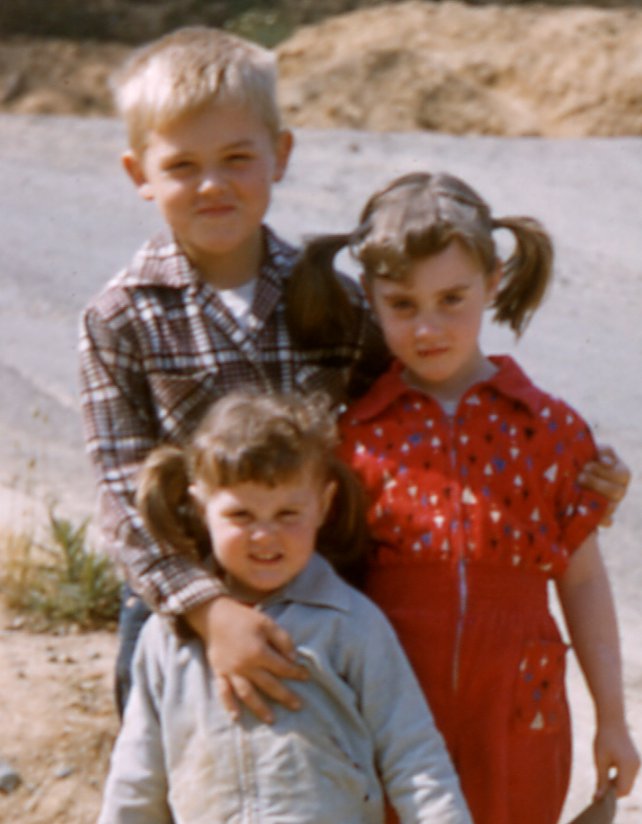
 By Catherine and Joseph Hedge
I’m fortunate to work on a project with artist- educator Francie Dillon. In the process, I’ve been researching websites for information on modern childhood play. In the technology, there is a great wealth of content, a world perspective, and rich visual and musical stimulation. I’m glad I get to watch my grandson learn in this new realm.
When we go outside, though, he reminds me of my dad. He’ll kneel on the sidewalk to draw chalk rainbows or watch ants build a hill. He finds elephants in the clouds and picks dandelions for his mommy. Maybe the ability to find happiness in the everyday sweetness of life is genetic. I hope so, for that gives him the promise of a life as fulfilling as his great-grandfather’s.
I hope you enjoy this glimpse of a childhood back in the late 1920’s and early 30’s. Dad kept this youthful glee all his life.
From the Shadows of Your Past
By Joseph Hedge
From the Shadows of Your Past
Have you ever swung a gate?
Walked a picket fence or a slippery log?
Thrown a stick into a creek
Just to please your dog?
From the Shadows of Your Past
Have you ever packed a picnic lunch
Hiked the hills alone with your pet?
Skipped a rock on a beaver pond?
Waded a creek till you’re soaking wet?
From the Shadows of Your Past
Have you ever hung on a street lamp?
Talked to your pals till bedtime?
Thrown pennies at a sidewalk crack?
Shot a taw in the direction you wish would come back?
From the Shadows of Your Past
Have you ever lain on the grass at night
And watched the Northern Lights?
Waited for the strong March winds
To fly your homemade kites?
In the Shadows of Your Past
These memories never fade
Fondly you cast
A backward glance
And remember the friends you made.
In the Light of Golden Days
What fun it is, My Love,
Remembering with you
How we chased the butterflies in flight
You know…I still do!
Posted in Nostalgia, Slice of life, Uncategorized, Writing
Tagged 1940's memories, Anaconda Montana, childhood, childhood games, grandhildren, Joseph F. Hedge, nostalgia, play, poetry, winter past
11 Comments
Bumper Stickers by Bishop
By Catherine Hedge
Last week, Marie and I were reminiscing about writing for Leonard Bishop. We’d work all week to write a great scene, hoping he’d say something like, “That’s perfect! I can’t think of a single thing I’d change!” Getting to hear that from him would be like having the Pope tell you, “You can forget about Purgatory. Go straight to Heaven!”
Mr. Bishop would always have something positive to say about our works. Then he’d follow with pointed advice about what could be changed and why our writing would become more effective if we did so. We’d take notes diligently, all the while thinking, “He’s wrong! It’s much better the way I have it.”
In the following days, I’d hear his gruff voice as I wrote. I tried to ignore it, but by the third day, I’d usually grump out loud, “Dang! Leonard’s right!” Then I’d set about rewriting the scene. Marie did the same thing. So did Donna. He made us better writers and we loved him for it, but it sure wasn’t easy!
Along the way, we amassed notebooks full of Leonard quotes. I used to put stars by my favorites. On his 77th birthday, I gave him a list of seventy-seven of his quotes. He read some of them to the party and exclaimed, “Hey! These are really good!” He was right.
I think these would make terrific bumper stickers for writers…or placards to put above our desks. The only problem is he’ll still be in the background, pushing us to try something new. I still hear him every time I write, “Cathy…take off the girdle! Take some risks.”
Dang, Leonard. You’re right!
(Here are the first eleven. I’ll add more in future blogs!)
- The writer’s mind is a steel room with a bullet ricocheting inside. (2/15/98)
- Climb as high as you can and step one step higher. (2/13/97)
- Take risks or you give the reader the opportunity to skim. (3/24/94)
- The first thing that gets sacrificed in the interest of good writing is the truth. (2/26/98)
- Writing is creating a select assembly of details to create an impression of reality with Mundanity left out. (4/8)
- If you have one trick you can do a thousand ways, you have a thousand tricks. If you have 1,000 tricks you can use one way, then you have one trick. (1/28/98)
- Novels have changed lives because themes become transposed into experiences and have the dynamics of persuasion. (3/24/94)
- Every scene needs to be important while you’re writing it. (5/12/94)
- We are part of a heritage of knowledge. Writing techniques were invented before we were born. (8/8/96)
- Every book that has ever been written was written using certain techniques. We can learn these techniques to become better writers ourselves. (8/8/96)
- Lyrical writing comes when you have reached the border in your conscious abilities. Learn by using up everything you already know and find new combinations. (12/19/96)


 Pen In Hand